
 As a new freshman walking across the Sam Houston State campus, Joe Sedillo was invited to play Capture the Flag. During the game, he was invited to Chi Alpha where he soon became involved with his first group of Christian brothers. It wasn’t until he attended a Discover the Nations conference that Joe began to feel a deep burden to disciple students from the nations and a call toward campus ministry. Receiving help from the Minority Mobilization Fund (MMF), Joe was able to complete his first year of the internship in a financially healthy place. The growth he experienced that year set him on a path toward a lifetime of campus ministry. Now after four years on staff at Sam Houston State, Joe and his wife Nicole are preparing for their next adventure. Along with their newborn daughter Quinn, the Sedillos are leading a Chi Alpha planting team to Buffalo State in New York. They plan to start in January 2019. Their team will be one of the first Chi Alpha plants in the Empire State, home to almost a million college students. It’s hard to think of a better investment of resources than in people like Joe who are taking the gospel to uncharted campuses around the country. Our MMF dollars have an immediate and eternal impact by equipping and sending minority laborers for the Kingdom of God. Thank you for making the MMF possible and joining in the pledge drive this month! More about the Minority Mobilization Fund....  As a commuter student, Tien didn’t have many friends when she started college. But through some people she knew from high school, she heard about Chi Alpha. Her life was dramatically changed as, for the first time, the love of Jesus was demonstrated to her. Through those relationships, she soon found Jesus and gave her life to Him.
During her time in college, Tien had the great privilege of discipling young women and seeing many come to Christ. During her junior year, she realized that campus ministry was something the Lord was leading her to do for the rest of her life. The challenges of support raising loomed large as most of her Vietnamese family did not support her financially. This past year Tien received anchor level support from the Minority Mobilization Fund (MMF) as an intern at the University of Houston. Today, you can find her leading her campus worship team, resourcing student leaders, and creatively promoting Chi Alpha on her campus. Tien sees herself in full-time ministry for the rest of her life. Experiencing first hand the strategic value of university missions, she can’t imagine doing anything else. She credits the MMF in helping her make the transition into a lifetime of missions. Thank you for helping the next generation of campus missionaries get on the field through giving to the MMF. We’re already seeing great fruit through your amazing and faithful generosity! 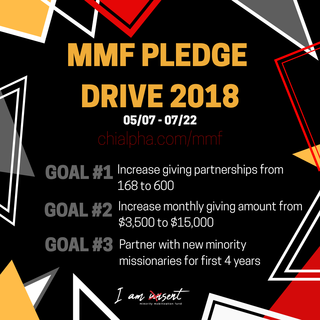 I am super excited to be in the midst of the 2018 Minority Mobilization Fund (MMF) Pledge Drive!* I love the MMF because it is helping Chi Alpha to wake the sleeping giant--sending out ethnic minorities into the university mission field. We will not be successful in completing the great commission without EVERYONE's participation! Here are a few reasons why it is so important to have a diverse missionary force--specifically in Chi Alpha in the USA from chialpha.com/mmf.
“Having a diverse missionary team shows the campus that the gospel is for everyone. Diversity opens doors and provides teams a broader voice. It also increases the diversity of gifts within our movement. Culture groups share unique strengths. We need diversity in our staff teams for the same reasons we pursue them in our stock portfolios to protect against potential weaknesses and increase our returns." Each person is created and uniquely gifted to reach certain people. We need all the gifts of all God's children to reach ALL people. I am so thankful for our Chi Alpha family that is partnering with the MMF to “Carry each other’s burdens, and in this way you will fulfill the law of Christ” (Galatians 6:2). *The MMF helps new minority missionaries by awarding Training and Anchor Level Support Grants. Training Grants are awarded to help with one-time costs such as RUI Registration, CMIT fees, and Berean courses. Anchor-Level grants provide fifteen percent of a new missionaries budget. More about the Minority Mobilization Fund.... 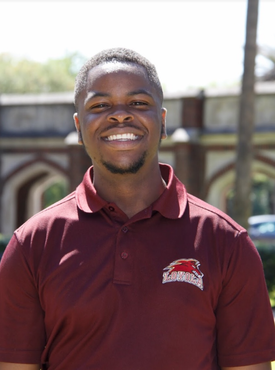 As a freshman at Loyola University in New Orleans, Joshua Byrd spotted a flyer advertising a worship gathering at the front of the school. Hoping to make friends, he attended and soon became part of Chi Alpha. Although as a student he felt God calling him to campus ministry and a burden to see students shaped by the love of God, he wasn’t sure what a career in campus missions would actually look like.
When it came time for graduation, Joshua received two different job offers from former companies he had interned at. Instead he chose to become a CMIT to be trained in campus missions. During his internship year, Joshua was one of the first ever recipients of an anchor level support grant from the Minority Mobilization Fund. He credits his anchor level support as a significant financial help, allowing him in part to be able to raise his support and pay his bills each month. What started off as one year of missions turned into two. Now each week, he disciples men on his campus and equips students to lead worship. Throughout the year he instructs student leaders and shares in preaching duties. Recently Joshua made an incredible five-year commitment to campus missions at Loyola. This next fall, he will be transitioning into the director role of Chi Alpha at Loyola, the same school where he started as a freshman years ago. The initial investment made by MMF donors into Joshua’s first year of ministry is continuing to pay dividends for years to come. Thank you, Chi Alpha Nation, for believing in this strategic effort to raise up laborers from all different people’s groups. More about the Minority Mobilization Fund....  “Who is my neighbor?” This is the question that prompted that great story we know as the Good Samaritan. You can read it in Luke chapter 10. This is how it came about:
On one occasion an expert in the law stood up to test Jesus. “Teacher,” he asked, “what must I do to inherit eternal life?” 26 “What is written in the Law?” he replied. “How do you read it?”27 He answered, “‘Love the Lord your God with all your heart and with all your soul and with all your strength and with all your mind’[c]; and, ‘Love your neighbor as yourself.’”28 “You have answered correctly,” Jesus replied. “Do this and you will live.”29 But he wanted to justify himself, so he asked Jesus, “And who is my neighbor?” I love Luke’s commentary in verse 29. He makes a point of telling his readers that the motivation behind the law expert’s follow-up question was to justify himself. How like an expert of the law to try to find a loophole in the great commandment. And how like our Lord to answer a question of geography with a story of behavior. Because, as this parable shows us, love is, after all, a verb. Jesus turned the word neighbor from a noun dealing with location to a verb dealing with action rooted in value. You see the Samaritan made a value decision when he decided to actively show kindness to the man who was robbed. He decided this man had great worth. He decided his neighbor was sacred. Jews had no dealings with Samaritans. This was due to a complicated history of abuse and oppression that caused each group to severely dislike and distrust each other. The road to Samaria was full of thieves, many of whom were most likely Samaritans. It was not unusual for a lonely traveler to fall the victim to crime. The man in this instance should really not have been traveling alone. That’s probably what the priest and the Levite who passed on the other side thought. Today we see it as a lack of compassion, they probably saw it as a sign of wisdom. If while traveling a dangerous road you come upon a victim of crime, you are left with little doubt that this is indeed a dangerous place and it is best to make good speed and get out of there fast! These two religious leaders were simply responding from the basic human instinct of self-preservation. Can we really blame them for that? Would we do any differently? Do we today? That is why the Samaritan’s behavior is so mind blowing. He does that exact opposite. He does not protect himself. On the contrary, he puts himself in danger in several ways. First, he places himself at risk by helping a Jew whose fallen victim to his own countrymen. Isn’t he siding with the enemy? Is he really thinking through what this could mean for him within his own cultural group? We think it sweet that the Samaritan showed kindness to the enemy of his people. Would his own people view it the same way? He also places his life in peril by taking this unconscious, naked Jew, putting him on his own donkey and taking him to an inn. What is to stop anyone he encounters along the way from thinking he is the criminal in this case? Here is the man on his donkey, in his possession. Think of the exact situation today. What would happen if an Israeli soldier came upon a fellow countryman naked, beaten, and unconscious in a Palestinian’s car? Would he thank the Palestinian or shoot him? Seen in this light, it seems the Samaritan could use some of the wisdom of the Levite and the priest. His actions really do not make sense. Why would he engage in such dangerous behavior? Obviously he values the life of this stranger, not just as much as his own, but more than his own. And that sounds just like the kind of point Jesus would make. After all he did say, “Greater love has no one than this: to lay down one’s life for one’s friends. (John 15:13)” The amazing truth here is that this man lays his life down, not for his friend, but literally for his enemy. This is so the kind of standard Jesus espouses, a truly insane--way beyond basic human instinct, reason, or common sense--definition of love. It is not the way of this world, but of our Father’s kingdom, modeled by our Lord himself. “But God demonstrates his own love for us in this: While we were still sinners, Christ died for us.” (Romans 5:8). The son laid down his life for his Father’s enemies. Are his followers to do less? Please hear me. What Jesus says to this expert in the law is more than a legal reply. He is not talking about how to meet conditions or standards. He is not sharing pretty platitudes regarding how we use our time and our need to make room for interruptions. He is saying to this man, to his hearers, to Luke’s readers, and to us today, that love is not a matter of geography and thus convenience. It is a matter of value resulting in dangerous, crazy actions. Of course, the parallels to our modern cross-cultural, cross-racial relationship are hard to miss. Today, in our country and our world, believers are tempted to huddle in groups under the banner of wisdom and self-preservation. We have our own histories that have resulted in dislike and distrust between neighbors and countrymen. But we are enticed to distance ourselves from them, to label them as other, and thus free from our compassion, kindness, understanding, or relationship. The world tells us to put aside our differences and tolerate each other, learn to live together. Our Lord asks us to lay down our lives and risk misunderstanding, repercussions, and even death to be a neighbor. YES, doing so will get us labeled and rejected by both our group and others. It will also put us in great company with Jesus himself. We can do no less when once we realize our neighbor is sacred. 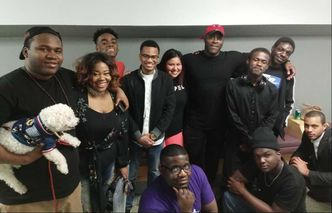 I. hate. waiting. I check Google to find the quickest way to work. I upgraded to the faster internet connection. My Volkswagen is turbo-charged. I want to get there, get it done, make it quick. In some ways, this mind-set has been helpful. It’s made me more productive, efficient, but in other ways, including planting ministry at Virginia Union University, it’s a character flaw.
Planting is by nature a slow process. Patience is required to allow a seed that’s placed in prepared soil to take root and grow. This is the stage our campus ministry is in at Virginia Union. We’re planting. After we chartered as an official Chi Alpha chapter last year, I quickly forgot that fact. I thought we were off and running. Guys were connecting in greater numbers in our student-led small group and a women’s small group was primed to start. Students were being led to Jesus and being baptized every semester. Outreaches on campus were making waves—it was happening and happening fast! Chi Alpha @ Virginia Union was going to be huge in a hurry. But that’s not the typical planting process and it wasn’t the case for us either. Soon we were faced with a student leader needing to step down. We saw those new Jesus followers transferring or just not returning to campus and some of our most promising potential leaders were being pulled away to other opportunities. We were frustrated, disappointed, and even at times infuriated. All of those emotions were valid, but shouldn’t have been unexpected. As we stepped back and recognized where we were as a ministry there was a realization. We needed to take the good with the bad and allow the seed of this new ministry take root. This is planting. We went back to work, building relationships and trust on campus. We submitted to the process of becoming an official student organization. Just finding a faculty advisor took over 6 months! Not quick, but all part of the planting process and we’re beginning to see the roots taking hold. Chi Alpha is now an official student organization. Our staff workers Marcus Floyd and Jasmine Yanez were invited to take an upfront role in a Union chapel service highlighting student organizations. Students are beginning to adjust their schedules to prioritize the Chi Alpha community and that community is continuing to grow. Jasmine and Marcus were recently invited to an Easter dinner hosted by the VUU International Student Association. In the middle of the event the ISA director Ms. Michele Brown, addressed them both and said, “you are a part of our family.” Chi Alpha at Union isn’t huge. Our grow curve isn’t on a record pace, but we’re more rooted than ever. And as those roots go deeper into the soil of Virginia Union we believe our impact on the campus will be more significant and sustainable. It’s a slow process, but it’s worth it.  This week our Chi Alpha visited Riverside church in Atlanta. Big shout out to Pastor Dale Stephens and Pastor Tim McNeeley and that crew. God is doing a good work through that ministry down there. During a morning devotional, we learned about the value we put on things. Pastor Dale asked us the question, “How can you help raise someone's value so that their identity will rise in value as well?
In our fight for kingdom diversity, we must be willing to put value on kingdom diversity. As we take a look at our leadership and our campus groups, does it reflect kingdom diversity? If it does not, what is it we must do to help our groups become more like the Kingdom of God? When we put value on Kingdom diversity, we will do whatever it takes. No matter the cost, no matter the comfort lost, we will make it happen. The questions we must ask ourselves to do this is:
As we do this, we will be fulfilling the Law of Christ; Love your neighbor as yourself. Let us set the standard of valuing every nation, tribe and tongue on our campus. SELAH  Last night I sat next to my daughter watching the figure skating competition for the Winter Olympics. We are not big figure skating fans, but she likes watching the competition, and I like making her feel nervous for the skaters as I shout “oh no don’t fall...” or “he’s going to drop her!” Not sure what that says about our relationship or me as a person, but it is so much fun. We also like to try to critique their outfits and guess their country. Most of the time, when guessing their country we are totally wrong because they are not usually wearing ethnic clothing and mostly all Europeans look....well, European. However, there was one skating pair that we both guessed correct without hesitation. It was a couple in which the man was white and the woman was black. We both at the same time shouted “France” and laughed.
Why is it that we can see a black and white figure skating couple and know that they must be French and are sure that they are not American. America is the most diverse country in the world, but the thought that a black and white mixed race couple would be representing us in the Olympics was never a thought for a 43-year-old black man and his 13-year-old daughter. What is it about France that makes us think of it as a place where a mixed race couple on an ice skating team is normal? And why is it that a mixed race skating couple from France is normal? Not one commentator mentioned their race. If it had been an American couple we surely would have heard, “This is the first black woman to skate in a mixed pair Olympic competition.” In the early 20th century, France was a safe haven for many black people seeking equality. W.E.B. DuBois, Josephine Baker, and James Baldwin are a few famous African Americans who moved there, but there were also thousands of African American soldiers who moved there after WWII. They bought property, fell in love with French women, started businesses, and lived a normal life. Could it be that there is a subconscious thought that real equality and opportunity for black people is something only to be found in France? I remember seeing Debi Thomas skate in the Olympics as a teenager, so I know America has had at least one African American ice skater in the Olympics. So I am not sure what the answer is, but the question intrigues me. Why do both my daughter and myself have a positive view of France in this situation and not America? Do I have similar subconscious thoughts about America and race with things other than sports? Do others think the same way or the exact opposite? So what’s my point? I don’t know that I have one. I guess I hope that whoever is reading this blog would take the time to think about why they think the way they do about race in America. That you would wonder if some of your actions and reactions are in response to subconscious ideas that have uncertain origins, but real outcomes. Does that affect your church or ministry? Does it affect your personal relationships or your reactions to strangers? Is it possible for you to pass those ideas on to people you lead or even your children? Something to think about.  "How do you expect me to be a man when I have never had a f^&@ing man in my life?!"
These words pounded my heart like a heavy weight descending through a bucket of water. I heard these words in a group of African-American young men I gathered with on Monday afternoons. This group, called B.O.S.S. (Brotherhood of Successful Scholars), had graciously taken me in and allowed this 30-something white guy from the cornfields of Indiana to be a part of their fellowship five years prior. On this particular night, we were exploring what it means to be a man and to hold your head high. The thoughts that flowed in discussion ranged from making money to showing the world that you should be respected to keeping your options open in your love life. The discussion began to pick up when someone interjected, "real men need to live with integrity." One of the young men in our group, who through his self-confession was attempting to leave behind a period of dealing drugs on campus, was troubled by this statement. He grew up in a home where there was no father, no husband and no male image-bearer of Christ. All he had known was his mom and grandmother. All he had known of being a man was to man up and make your way through; keep living and surviving, do what you need to do to stay alive. Now, he is being told to be a man with integrity. What exactly is that? This discussion got me to thinking: I believe we assume to much. We assume that if we tell people to do something that they will already know what that something is. We assume people have a mutual baseline of common sense (thus revealing our naivete). We even assume that varying people groups in this nation will all see things from the same point of view (yikes!). In this case, this young man got me to thinking about my assumptions. Do I assume young men know what it will look like to be a man? Do I assume that even from one people group to another there will be common streams of thought and standards for manhood? I make too many assumptions... However, here is where the good news comes in: just like Paul told the Colossians (1:24b) "...in my flesh I do my share on behalf of His body (which is the church) in filling up what is lacking in Christ's afflictions." (NASB), I also had the same opportunity. We have the same opportunity. What the believers in Colossae lacked was not hearing what Jesus had done for them, or believing what Jesus had done for them. No, what they lacked was flesh and blood; seeing what Jesus had done for them. Thus, through Paul's suffering for proclaiming Jesus' Name, these believers were able to see and experience in flesh and blood what that looked like. Similarly, young students (esp. young men) on our campuses throughout the country have heard about men...fathers, husbands, men of integrity...but until they see these men they may not truly believe they exist. Until they can experience them in flesh and blood, there will be something pivotal missing in their lives, freeing them to change the trajectory of their lives to in fact become these men of integrity. Until they can rub elbows with, ask questions to and do life with these men, they will not be able to become one of them. Here is where we come in: we can do this. What I realized was that my ministry amongst this group of African-American young men was me. I needed to live out what a quality husband looked like, what a father who cared about his children was, and what a man of integrity looked like in flesh and blood. I need not focus on being super relatable or even pretend to understand all that they go through as a minority. Just love them where they were for whom they were, and then show out what a man of God looks like. No performance needed, only truth, integrity and care. Already we have seen some young men's lives dramatically changed by the Gospel because of this. We can do this. Can we take some time to look about us and see what assumptions we have that we may need to reconsider? Can we take a few moments to consider who has lack around us (like the Colossians) that we may be able to fill up with our flesh and blood? If so, the Spirit will make you aware of opportunities around you that need Gospel, that need flesh and blood. May you become good news to those lacking around you.  “Are you for me or against me?”—this was my thought as I waited at traffic intersection and looked at the driver in the vehicle adjacent to me. Why did this question creep into my mind on a seemingly calm Sunday afternoon? The simple answer is: distrust is sneaky.
The man driving the vehicle I was looking at was an older, Caucasian male. I am a younger, Hispanic male with brown skin and what I like to think of as a beard (on most days). We were both in Charlottesville the day after our entire nation witnessed the violent and racist events that transpired in our little city back in August 2017. In that moment at that intersection I was being tempted with a choice to treat my White neighbors with suspicion. Never before had I experienced the fear of discrimination as an ethnic minority in the city of Charlottesville until that day. The longer I pondered this feeling, the more I began to realize how sinister and destructive hatred is. I’d like to offer two insights into this personal experience I had. As a disclaimer, I’d also like to say that my comments aren’t meant to reflect the feelings of all minorities. These are just my humble, Hispanic-American-Christian opinions. Take them as you wish. First, I think it’s important that we as a body of Christ’s disciples would choose trust over suspicion. Within our Chi Alpha group at the University of Virginia, this is one of our “24 axioms,” scripture-based phrases that our community lives by. This axiom is one I often need to be reminded of. It shouldn’t be a surprise that suspicion can destroy relationships. However, what I often find surprising is how it creeps into my life, like that day at the intersection. It feels justified, it feels cautious, and it even seems logical. I’ve observed how on our campus there are many people who live in fear of being discriminated against and how there are also those who live in fear of being seen as discriminators. What a paradox to live in; at every turn people are suspicious of one another. I can imagine the thoughts of a hypothetical situation where two strangers pass each other. One thinks of the other: “Do you see me as less than you because I am not White?” While the other stranger wonders: “Do you automatically see me as a bigot because I am White?” This is how destructive suspicion can be in the hearts of people. Paul encourages the church “to be made new in the attitude of your minds; and to put on the new self, created to be like God in true righteousness and holiness,”(Eph. 4:23-24 NIV). Christ taught us a better way to live with one another, even with those who do not profess his name. Christ taught us to love. In a recent Voice of the Martyrs podcast, Edward Aruba, a former Bangladeshi Muslim, recounted the story of beating-up a Christian student who tried to share the Gospel with him. He mentioned how surprised he was to see the Christian student return to him days later, with bruises and scars. Edward expected retaliation; but instead he was faced with love, friendship, and one of the biggest smiles he had ever seen. This show of love was the catalyst that turned a staunch Muslim into a redeemed and reborn follower of Christ. Love beautifully disarms hearts. Even when someone believes the worst in me and acts upon that, I am still called to love extravagantly. Edward’s story is an example of how true Jesus’ words in John 13:35 are, “By this everyone will know you are my disciples, if you love one another.” It’s not about having all the answers, the most knowledge, or the best arguments. It’s about choosing love, especially in the face of suspicion. Secondly, as a minority, I’d like to encourage other minorities to propagate understanding and not hatred. Recently, we held an outreach at our university where we engaged students by asking them, “How do you address racism?” Many students brought up the important topic of stopping microaggressions. I was saddened by the bitterness in many of them (the minorities) who recounted situations where they received unwarranted generalizations and remarks based on their ethnicity. One even commented about how close she was to punching someone after receiving an insensitive comment. The Scriptures teach us of the power of our words in various places (Prov. 18:21; 19:1, 5, 9, 28). We should guard our words and speak lovingly and considerably towards others; but what good is it to just stop acts of microaggressions while holding on to the bitterness of the experience? This is why we need to promote understanding. It’s important for all people to know why their comments are hurtful, how they can respectfully refer to others, and how to affirm diversity. There will always be people “less educated”on matters of diversity around us because we live in a diverse world. I didn’t choose to be born into a third-world country or to grow up in the melting pot of New Orleans. You can’t fault someone for growing up in an ethnically homogenous environment. Often times, I’ve met students at our university who say UVA is the most diverse place they’ve lived in! I firmly believe that Universities are strategic places to teach others on the value of diversity. Yes, you’re right, not everyone is interested in educating themselves on why calling me a “beaner” is offensive (because I prefer the term “luchador” . . .). Yes, there are those who despite their diverse, university setting would prefer to live ethnocentrically encapsulated in their homogenous world. To that I say, "I am innocent of this man's blood," as Pilate did after washing his hands in front of the crowd about to crucify Jesus. If they are unwilling to listen, unwilling to learn, that’s on them; but let it be far from me that I withhold wisdom from a weaker brother if I have it. In my experience, this has not been the majority of people I have encountered, so the “benefits” outweigh the “risks.” What a shame it would be if I gave into the feeling of suspicion that moment at the traffic intersection. My heart can be so easily “prone to wander,” as that timeless hymn says. I pray that it would continually wander into the grace and love of Christ. I hope my opinions are helpful for you. Again, you don’t have to agree with them; but at least I hope they help you process your actions next time you find yourself at a personal, metaphorical intersection. |
Categories
All
Contributing Authors
|
 RSS Feed
Proudly powered by Weebly